
Airflow Bottomless Portafilter: How to Choose the Right Size and Use It Without the Mess
The short answer
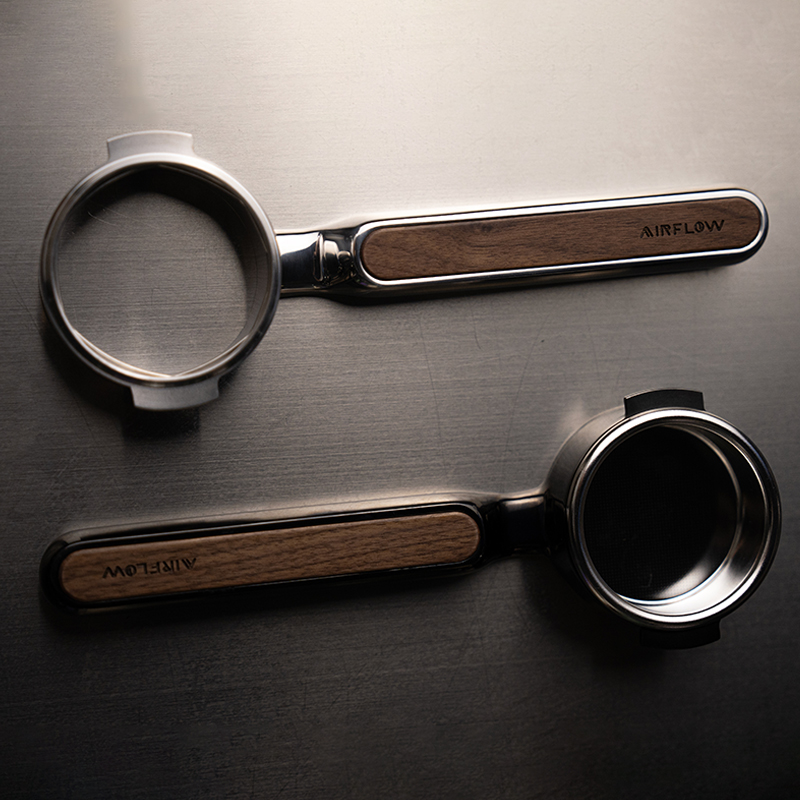
Buy the Airflow bottomless portafilter if you brew on a 58mm machine and you want to see what your puck is doing. It is 58.5mm, with a lay-flat design, a walnut handle and 304 stainless steel, and the handle stays vertical even when tamping, so the portafilter sits flat and steady while you work. It fits home baristas learning to diagnose their shots, and cafes that want every barista to see the same evidence on every shot. It does not fit you if your baskets are 51mm or 54mm — a 58.5mm portafilter will not fit a smaller group, and no technique fixes the wrong size. Check your basket size before you order, and if you are not sure, measure the basket rather than guessing from the machine name.
What a bottomless portafilter actually does
A normal portafilter has spouts that collect the coffee and guide it into the cup. A bottomless portafilter has no spouts and no bottom: the basket is open underneath, and the espresso falls straight out of the puck. That is the whole difference, and it changes everything about diagnosing a shot.
With spouts, a bad shot and a good shot look the same until you taste them. With a bottomless portafilter, you watch the extraction happen. A good shot starts with drops appearing evenly across the whole basket, then joins into one steady stream in the centre. A bad shot shows itself at once: thin jets spraying sideways, one side running while the other stays dry, or the stream breaking apart halfway through. That view is why baristas use bottomless portafilters to learn — the feedback is instant, and it is impossible to ignore.
The Airflow bottomless portafilter is built for that job. The lay-flat design means it sits flat on the bench, and the handle stays vertical even when tamping, so the basket stays level while you press. The handle is walnut with 304 stainless steel, and it does not get hot to hold even after 40 cups in a row — the handle stays comfortable through a full shift, not just the first few shots.
How to choose the size
Check the basket first, not the machine brand. The Airflow bottomless portafilter is 58.5mm, which fits 58mm baskets. If your basket is 58mm, this is the size. If your basket is 51mm or 54mm, it is not — the portafilter will not lock into a smaller group, and forcing it will damage the group seal.
Do not guess from the machine name. Machines that look the same size can take different baskets, and the same brand can sell 54mm and 58mm models side by side. Take the basket out, measure across it, and order the size that matches the measurement. One minute with a ruler saves a return.
If you run a cafe with several machines, check every machine. A bar with one 58mm machine and one 54mm machine needs two different portafilters, and ordering one size for both leaves one machine without a portafilter that fits.
How to use it, step by step
Start with the dose. Weigh it on the scale — the Airflow coffee scale reads to 0.1g — so the dose is the same every time. Grind into the basket, then run the magnetic WDT through the grounds in a few gentle passes: 8 needles at 0.4mm, breaking up clumps and evening the bed. Fit the magnetic dosing ring while you work, with its 73mm wide opening and 6 magnets, so the dose stays in the basket and off the counter.
Level the bed with the gravity-adaptive distributor: 58.5mm, 9-face plate, 7.79° angle and 8mm depth, reducing channelling before the tamp. Then tamp. This is where the lay-flat design earns its place — the handle stays vertical even when tamping, so the portafilter sits flat on the bench and the tamp lands level instead of tilted. A tilted tamp is the most common cause of the one-sided flow a bottomless portafilter will show you.
Lock the portafilter in, put the cup underneath, and pull the shot. Watch the bottom of the basket, not the cup. Drops should appear across the whole basket at roughly the same time, then join into a single stream. If they do, the puck is even. If they do not, the shot is telling you what to fix — and the fix is in the prep, not in the portafilter.
For the full routine this portafilter belongs to — WDT, distributor, tamp, in order — see our article Magnetic WDT vs Distributor: Which Puck Prep Tool Should You Buy First?, and for the complete station set, see How to Equip a Cafe Bar With One Espresso Prep Set.
Why bottomless shows channelling
Channelling is water finding the easy path through the puck instead of passing through it evenly. A clump, a crack, or a tilted tamp leaves a weak spot, and the water rushes through it, over-extracting one part of the puck and under-extracting the rest. The shot tastes sour and bitter at the same time, and it runs fast.
With spouts, the streams mix before you see them, so channelling hides. With a bottomless portafilter, there is nothing between the puck and your eyes. A channel shows as a thin jet spraying sideways from one spot, while the rest of the basket drips slowly or not at all. That jet is the diagnosis: the puck was uneven in that spot, and the fix is a better distribution — WDT first, then level, then tamp — not a different portafilter.
Over time, the bottomless portafilter teaches the hand. Baristas who watch their extractions learn what an even puck looks like, and they learn it faster than baristas who only taste the result. That is the real reason to own one: it is a training tool as much as a brewing tool.
Three mistakes to avoid
1. Grinding too fine
A grind that is too fine chokes the shot: the water cannot get through, the pressure builds, and the shot sprays sideways or barely drips. If the bottomless portafilter sprays on the first shots, coarsen the grind a step before blaming anything else. The portafilter is showing the grind, not causing it.
2. Tamping on a tilt
A tilted tamp presses one side of the puck harder than the other, and the water runs through the loose side. Tamp on a flat surface, with the portafilter sitting level — the lay-flat design and the vertical handle make this easy, but only if the portafilter is actually flat on the bench when you press. Check that it sits level before you tamp, not after.
3. Skipping the WDT and the distributor
A bottomless portafilter shows every flaw in the prep, and skipping steps gives it plenty to show. Grinding straight into the basket and tamping, with no WDT and no levelling, is the fastest way to a spraying shot. The portafilter did not cause the mess — it revealed the prep that was already uneven. Use the full routine, and the bottomless view becomes boring: one even stream, every time.
FAQ
Will it fit my machine?
It fits 58mm baskets. Check your basket size before ordering — measure the basket rather than guessing from the machine name. If your baskets are 51mm or 54mm, this portafilter will not fit. Machine-group compatibility beyond the basket size is not stated in the Airflow specification, so confirm the fit with your machine's basket before ordering.
Why does coffee spray out sideways?
Spraying is channelling: water is forcing its way through a weak spot in the puck. The usual causes are a grind that is too fine, clumps that were not broken up, or a tilted tamp. Fix it in the prep — coarsen the grind a step, run the WDT through the grounds, level with the distributor, and tamp flat. If the spraying stops, the prep was the problem.
Can I use it with a tamper?
Yes — it is made to be tamped on. The handle stays vertical even when tamping, so the portafilter sits flat on the bench while you press. Airflow's own coffee tamper is 58.5mm, 266g, in walnut and 304 stainless steel, matching the portafilter's basket size. Tamp on a flat surface, and keep the portafilter level while you press.
The decision in one line
If your baskets are 58mm and you want to see your shots instead of guessing at them, a bottomless portafilter is the fastest teacher on the bar — and the handle that stays vertical and cool through 40 cups means it is built for a full shift, not just a demonstration. For cafes and chains stocking up, the portafilter is available wholesale at a 1-carton MOQ per item, with samples available and most items in stock.
 Coffee Accessories Wholesale: How Distributors Build a Range That Sells
 Airflow Bottomless Portafilter: How to Choose the Right Size and Use It Without the Mess
 Airflow Coffee Scale: How to Choose a 0.1g Scale With Timer for Espresso and Pour-Over
How to Test Espresso Tools Before a Wholesale Order: Samples, Trial Orders and the First Carton