OEM and ODM Coffee Tools: How to Private-Label Espresso Accessories
The short answer
Choose the Airflow brand if you want to start selling now: the range exists, most items are in stock, and the wholesale MOQ is one carton per item. Choose OEM if you want your own brand on proven designs — the product stays the same, the branding changes. Choose ODM if you need a product changed or developed to your specification, and accept that development takes longer than ordering stock. OEM and ODM fit distributors, retailers and machine brands with their own channel and brand to build. They do not fit a first order: a buyer who has not yet sold the category should test the branded range first, because a private label multiplies whatever demand is already there — including zero.
OEM and ODM are not the same thing
OEM (original equipment manufacturing) means the manufacturer's existing product, made and branded for you: your logo, your packaging, the same design and specification that already sells. The work is in branding and packaging, not in product development, so it is the faster of the two routes.
ODM (original design manufacturing) means the manufacturer develops or adapts a product for you — a changed dimension, a different finish, or a design built from your brief. The work is real product development, with samples and revisions, so it is slower and belongs after you know the category sells for you. Airflow designs its own products and manufactures to its own standards — stainless steel is the main material, produced through its own invested factory, with other materials made by partner factories to Airflow's designs — which is what makes ODM possible at all: the design capability is in-house.
Who each route fits
The branded range fits most buyers first
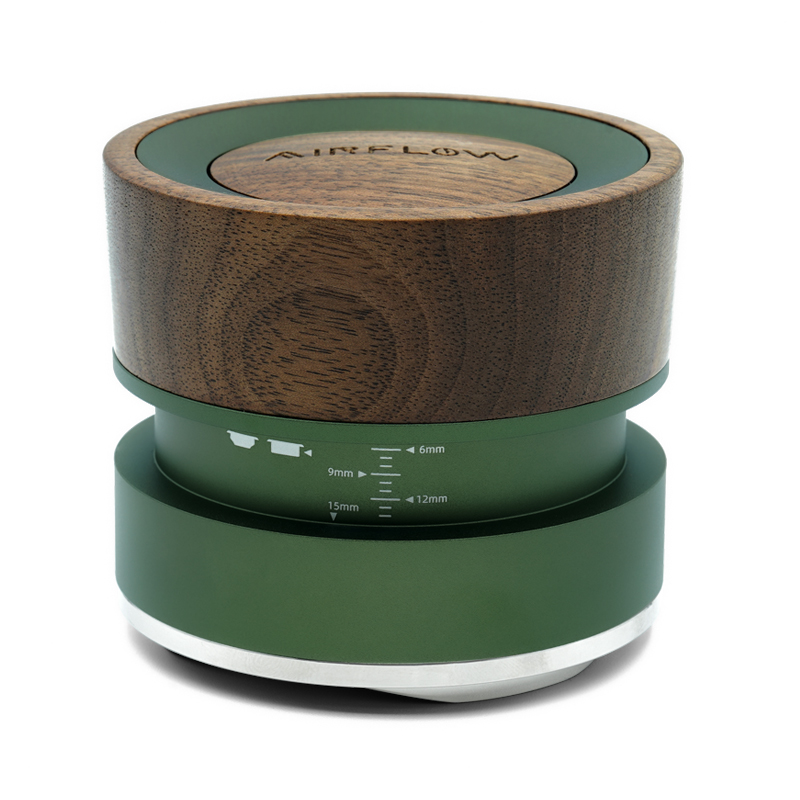
If you are adding espresso tools to an existing shop or distribution range, the branded range is the practical start: gravity-adaptive distributor, magnetic WDT, dosing ring, coffee scale, milk pitchers and the rest of the prep chain, at one carton per item, samples first. Your customers buy the tools; your margin and your channel do the work. Most Airflow partners start here.
OEM fits buyers building their own shelf brand
If your customers buy your brand rather than the manufacturer's — a retail chain, an equipment brand filling out its accessory line, a distributor with its own label — OEM puts that brand on designs that are already proven in the market, without development risk.
ODM fits buyers with a specific gap
If your market needs something the standard range does not have — a different size, a bundle built for one machine ecosystem, a finish matched to your other products — ODM is the conversation to have, with samples and testing before any volume, the same discipline as any wholesale order.
What to decide before you ask
1. Which products, and why those
Private-label the tools you already know sell, not the whole catalogue. The prep chain — distributor, WDT, dosing ring, scale, pitcher — is where most buyers start, because the tools sell as a set. For how the range is built, see Coffee Accessories Wholesale: How Distributors Build a Range That Sells.
2. Branding scope
Decide what carries your brand: the product itself, the box, or both. Each is a different conversation about artwork, printing and packaging, and it is cheaper to settle before samples than after them.
3. Volume honesty
Say the real expected volume, even if it is small. A supplier plans differently for a test quantity than for a standing monthly order, and a small honest number gets a workable answer; an inflated one gets a plan that collapses later. Note that the one-carton MOQ quoted on this site is the wholesale term for the branded range — OEM/ODM quantities are agreed per project, so ask rather than assume.
4. Testing before branding
Test the standard product first, branded or not. A logo does not fix a tool that does not suit your customers. The sample-and-trial method in How to Test Espresso Tools Before a Wholesale Order applies to private label exactly as it does to the branded range.
FAQ
Does Airflow offer OEM and ODM?
Yes. Airflow's own brand is the main offer, and OEM/ODM is available. Which route fits depends on whether you need your branding on existing designs (OEM) or a product developed or adapted to your specification (ODM).
What is the minimum order for OEM or ODM?
The one-carton-per-item MOQ on this site is the wholesale term for the branded range. OEM/ODM quantities are agreed per project, based on the product and the branding scope — ask with your expected volume and you will get a direct answer.
Should a new distributor start with private label?
Usually not. Start with the branded range, learn which tools your customers actually buy, then private-label the proven sellers. A label multiplies existing demand; it does not create it.
The decision in one line
Sell the branded range first, private-label what proves itself, and treat ODM as a development project, not an order — that order of steps is what makes a label worth having. For the sourcing checklist behind all of it, see Distributor Wholesale Buying Checklist.
 OEM and ODM Coffee Tools: How to Private-Label Espresso Accessories
 Why Your Espresso Channels: Five Causes and How to Fix Each One
 Magnetic Dosing Ring: What It Does, How to Choose One, and How to Use It
Coffee Accessories Wholesale: How Distributors Build a Range That Sells